
Honouring Oral History in the Wake of Loss
The tradition of oral history in the Cayman Islands wasn’t practised out of luxury or choice—it emerged out of necessity. For centuries, we’ve passed down our stories through spoken word, not because it was convenient, but because time and tragedy often stripped away every other way to preserve our past.
In 1785, a hurricane struck our islands with such force that a tidal wave levelled every single building—except Pedro’s Castle. That storm didn’t just flatten the landscape; it erased government documents, personal letters, photographs, and family homes. In its aftermath, the people of Cayman had to rebuild more than structures—they had to reconstruct memory.
“This hurricane was nothing compared to the 1785 one, which was so terrific in its force that it tore up all except one tree at South West Point. Every house except the stone house at Pedro was blown down. A tidal wave occurred, and after the recession of the tidal wave it was possible to walk on dry land from West Bay to South West Point. Many lives were lost—by falling trees, collapsing houses, and drowning. The number of vessels lost was unknown.”
Notes on the History of the Cayman Islands by George S. S. Hirst
— An elderly man from North Side to Mr. J. S. Watler of Spotts, circa 1845
“Records of this hurricane I believe had been preserved, but were lost in later storms when houses blew down and papers were blown to the four points of the compass.”
— George S. S. Hirst
Time would prove this wasn’t a singular event. In 1932, the islands were battered again by what was then the most devastating hurricane on record. The losses were achingly familiar: lives, homes, photographs, letters—gone. And then again, in 1972, a fire consumed the government building that housed much of our national archive. Decades of history went up in smoke, and officials were left to gather the scraps of what remained.
Even in our recent history, we’ve known this pain. In 2004, Hurricane Ivan carved a brutal path across our islands. It destroyed not only physical infrastructure but also digital memories—computers, photographs, Nor’Wester magazines, issues of the Cayman Compass, and countless other records of who we are.
I often say our history has been washed away as frequently as the sand shifts with the sea—sometimes, quite literally. Yet from these repeated losses, Caymanians have learned a powerful truth: that memory must live in many forms—spoken, written, printed, recorded. Because at any moment, it can be taken from us.
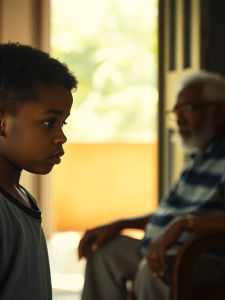
One evening, in quiet conversation with a friend, he told me of his grandfather—a man who was blind, yet gifted with vision far beyond sight. Though unable to see, he painted entire worlds through his storytelling. He spoke of his childhood, of hardship, of a Cayman that now feels like a foreign country to us. I recognised that feeling. I too have sat with elders and listened to them speak of another Cayman—one so different, I sometimes wonder if it was the same land I now call home.
Another memory shared with me was of a time when there were few, if any, planes flying to Cayman. Back then, our food came in by ship. The seamen would blow their conch shell to announce their arrival, and my friend recalled how his mother would give him a few pence and send him down to the iron shore to fetch some fish.
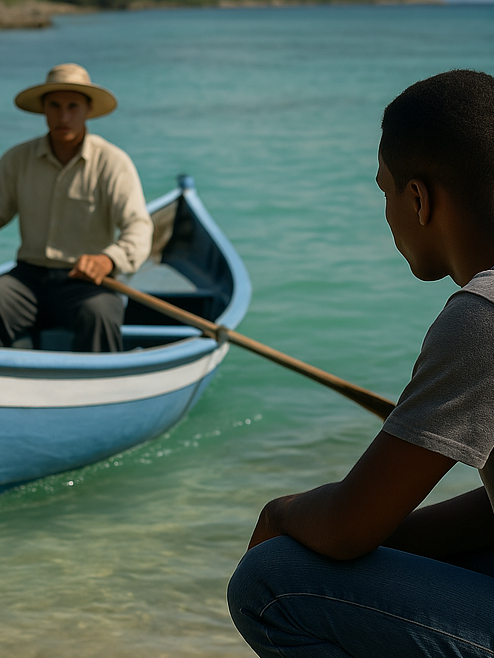
He’d find the crew and say, “Boy, sir, I have no idea. My mummy gave me some money and I just want to get some fish for her.” These are the kinds of stories that live outside of textbooks—but they’re the soul of a nation.
That’s the beauty of oral tradition—you get to step into another time, another world, one you’ve never imagined, yet one that exists just beneath the surface of the present.
So when people tell me that Cayman has no culture, no tradition, no history, I cannot agree—nor can I stay silent. These comments come not from malice, but from a lack of access to the stories that define us. My hope is to close that gap. To bring people closer to the Cayman they never saw. The traditions we never knew. The culture that is still here—vibrant, layered, and resilient.
That’s why I created Soft Fresh Breeze—a project rooted in preservation and pride. I scan Nor’Wester magazines, old books, photographs. I digitise videotapes and camcorder footage. Each item I archive is a thread in the fabric of our identity.
Through Soft Fresh Breeze, I’ve shared adapted stories—narrated, retold, celebrated. But now, I’ve taken the next step.
Fly on the Wall being the evolution of that journey—and I’ve recently recorded my first episode.
It’s important to clarify that Fly on the Wall isn’t political in nature. It may feature individuals who have entered politics, but not because of their positions—instead, because of their passion. Because of the ways they’ve chosen to make a difference, using the tools and platforms available to them. Their stories are part of our national tapestry, too.
My first guest was Em DeCou. Sometimes, you don’t realise what—or who—will be the catalyst for your journey. When she announced her candidacy last November, I did some research and said to myself, This person is interesting. If not today, they’ll leave a lasting mark on this country—and for the better.
Of course, the universe rarely lets thoughts like that rest quietly. It moved. We met—by chance, or maybe fate—and when I asked her to be my first guest, she didn’t hesitate.
Her openness, her willingness, and her trust gave me the gift of a beginning. I’ll always be grateful to her for that. Together, we captured a piece of the essence of one young Caymanian. And I hope to do the same with many more—young and old.
If you know someone whose story deserves to be told, I will do everything in my power to make it happen. This is important to me—not because I’m a generational Caymanian (because I’m not), but because I am Caymanian. This is the only home I’ve ever known, and through these stories, I’ve come to know it more deeply than ever before.
Our younger generations won’t consume history the way we once did. They may not read bound books or tune into radio broadcasts. Today, it’s podcasts, YouTube, and digital content that carry the most reach. And so, I will meet them there—with stories worth hearing.
I hope you’ll support this effort. If you know someone with a story to tell—or if it’s you—please don’t hesitate to message or email me. I would be honoured to help you share it.
Because every voice matters. And every story deserves to live on.
Capturing moments – One Frame at a Time
Matt Fox Seales
 Fox Seales Gallery